Christopher McCarroll is a Postdoctoral Researcher at the Centre for Philosophical Psychology, University of Antwerp. He works on memory and mental imagery, with a particular interest in perspective in memory imagery. In this blog post Chris talks about his recently published book Remembering From the Outside: Personal Memory and the Perspectival Mind.

In his 1883 study into psychological phenomena, Francis Galton described varieties in visual mental imagery. Writing about the fact that some people "have the power of combining in a single perception more than can be seen at any one moment by the two eyes", Galton notes that "A fourth class of persons have the habit of recalling scenes, not from the point of view whence they were observed, but from a distance, and they visualise their own selves as actors on the mental stage" (1883/1907: 68-69). Such people remember events from-the-outside. In the language of modern memory research such images are known as ‘observer perspective memories’. Not everybody has such imagery, but are you one of Galton’s ‘fourth class of persons’? Do you recall events from-the-outside?
This perspectival feature of memory is a puzzling one, and it raises many questions. If the self is viewed from-the-outside, then who is the observer, and in what way is the self observed? Are such memories still first-personal? What is the content of such observer perspective memories? How can I see myself in the remembered scene from a point of view that I didn’toccupy at the time of the original event? Indeed, can such observer perspectives be genuine memories? In the book I provide answers to such questions about perspective in personal memory.
There is now a broad consensus that personal memory is (re)constructive, and some of the puzzles of remembering from-the-outside can be explained by appealing to this feature of memory. Indeed, it is often suggested that observer perspectives are the products of reconstruction in memory at retrieval. But this, I suggest, is only part of the story. To better understand observer perspectives in particular, and personal memory more generally, we need to look not only at the context of retrieval, but also at the context of encoding.
This constructive and reconstructive aspect of memory allows us, in a sense, to get outside of ourselves. This is not to suggest that you have to literally see yourself during the perceptual experience in order to see yourself in a memory of that experience. When remembering from- the-outside you are not remembering seeing yourself at the time of the event.
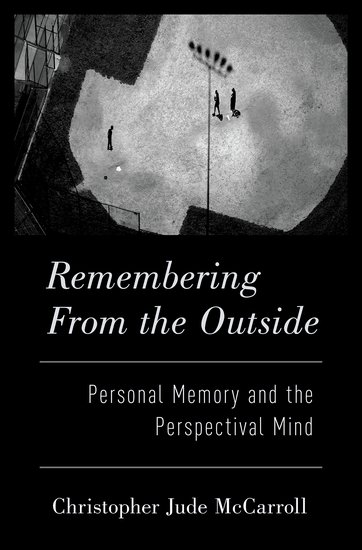
In his 1883 study into psychological phenomena, Francis Galton described varieties in visual mental imagery. Writing about the fact that some people "have the power of combining in a single perception more than can be seen at any one moment by the two eyes", Galton notes that "A fourth class of persons have the habit of recalling scenes, not from the point of view whence they were observed, but from a distance, and they visualise their own selves as actors on the mental stage" (1883/1907: 68-69). Such people remember events from-the-outside. In the language of modern memory research such images are known as ‘observer perspective memories’. Not everybody has such imagery, but are you one of Galton’s ‘fourth class of persons’? Do you recall events from-the-outside?
This perspectival feature of memory is a puzzling one, and it raises many questions. If the self is viewed from-the-outside, then who is the observer, and in what way is the self observed? Are such memories still first-personal? What is the content of such observer perspective memories? How can I see myself in the remembered scene from a point of view that I didn’toccupy at the time of the original event? Indeed, can such observer perspectives be genuine memories? In the book I provide answers to such questions about perspective in personal memory.
There is now a broad consensus that personal memory is (re)constructive, and some of the puzzles of remembering from-the-outside can be explained by appealing to this feature of memory. Indeed, it is often suggested that observer perspectives are the products of reconstruction in memory at retrieval. But this, I suggest, is only part of the story. To better understand observer perspectives in particular, and personal memory more generally, we need to look not only at the context of retrieval, but also at the context of encoding.
Memory is not only reconstructed at the time of retrieval, but even at the time of the original event, through constructive processes of encoding, we are attending to, selecting, abstracting, interpreting, and integrating information from various sources into a memory of the event. A memory that may be recalled from-the-outside.
This constructive and reconstructive aspect of memory allows us, in a sense, to get outside of ourselves. This is not to suggest that you have to literally see yourself during the perceptual experience in order to see yourself in a memory of that experience. When remembering from- the-outside you are not remembering seeing yourself at the time of the event.
 |
| Chris McCarroll |
Rather, observer perspective memories are much more quotidian than this. Indeed, this everydayness of remembering from-the-outside is a feature to be explained in its own right, and one I account for in the book. Yet by explaining the commonplace character of observer perspectives, the book also points to an important way in which our minds are perspectival.
We experience the world from a particular perspective, from our own point of view, but this is much too simple. The mind is perspectival in much more interesting ways. We can adopt internal and external perspectives on ourselves in a variety of cognitive domains, and these distinct perspectives can convey different information and promote understanding.
We experience the world from a particular perspective, from our own point of view, but this is much too simple. The mind is perspectival in much more interesting ways. We can adopt internal and external perspectives on ourselves in a variety of cognitive domains, and these distinct perspectives can convey different information and promote understanding.
Indeed, perspectives which go beyond the purely egocentric are not only found in memory, but in imagination, dreams, spatial cognition, art, language and gesture, and they provide a way of thinking about and interpreting our experiences, events, and environments.
Remembering from-the-outside is an interesting phenomenon in its own right, and it provides a useful lens with which to view a range of other intriguing issues. In this book I integrate insights from a range of sources―from philosophy and phenomenology, through cognitive and social psychology, to memoir, poetry, and prose―to elucidate and explain the puzzles related to remembering from-the-outside and to shed light on the nature of personal memory and the perspectival mind.
Remembering from-the-outside is an interesting phenomenon in its own right, and it provides a useful lens with which to view a range of other intriguing issues. In this book I integrate insights from a range of sources―from philosophy and phenomenology, through cognitive and social psychology, to memoir, poetry, and prose―to elucidate and explain the puzzles related to remembering from-the-outside and to shed light on the nature of personal memory and the perspectival mind.