Emotion and Prediction

In this post Mark Miller (Center for Human Nature, Artificial Intelligence and Neuroscience, Hokkaido University) reports on a workshop Emotion and Prediction, which was held online on March 31- April 1, 2021.


Emotion permeates all mental life - it reflects our adaptivity, it imbues our activities and our environments with meaning and purpose, and it motivates and modulates our behaviours. We are emotional creatures through and through. While there has been a tremendous amount of work done on this topic, to date an integrative account capable of unifying the various theoretical perspectives and experimental results is still lacking.

A recent workshop Emotion and Prediction brought together philosophers, cognitive scientists and machine learning researchers to explore the implications of a leading new framework emerging within computational neuroscience for the study of feelings, emotions and moods. The Predictive Processing (or Active Inference) framework starts from the vision of the brain as a prediction machine - a machine whose modus operandi is the minimization of discrepancies between what it predicts about the world and the world itself. 

This framework offers a powerful new architecture in which distinct functions can be explained at their different time-scales by the same computational principles, and where distinct theories can find a common language. As such it has quickly become an attractive way of carrying out theoretical and experimental research in the cognitive sciences. This workshop brought together six researchers working in this field, to present their original research on the possibilities this framework offers to the study of emotion.


Regina Fabry


Day one began with philosopher of cognition Dr. Regina Fabry’s (Ruhr University) talk "What is the Relationship between Emotions and Moods? Predictive Processing and the Affective Mind". Regina developed a new computational approach to understanding the dynamic relationship between emotions and moods, all revolving around the dynamics underlying prediction error minimization.


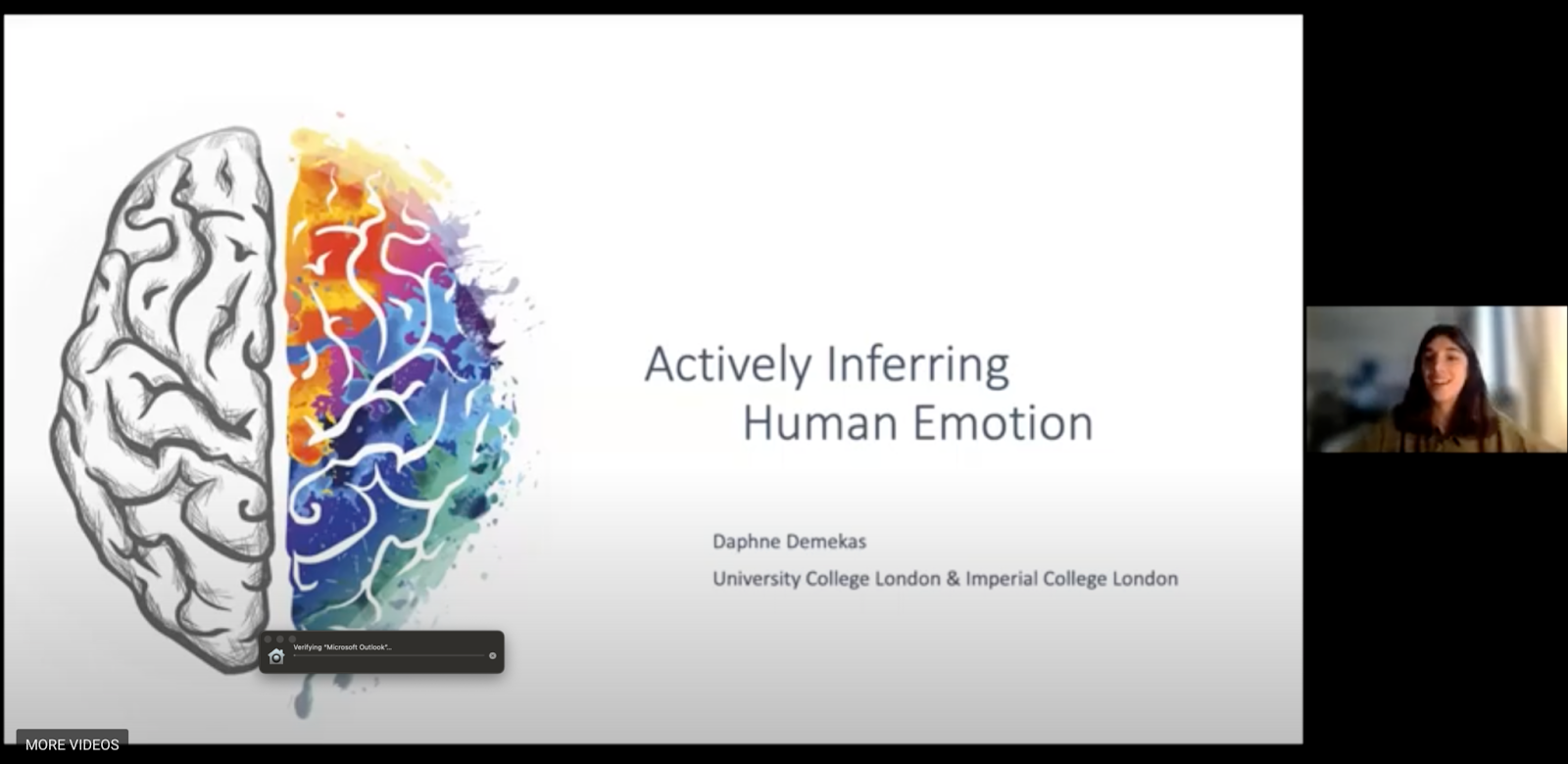
Next, Daphne Demekas, a graduate student of machine learning at Imperial College London, presented her exciting new paper (alongside Karl Friston) "An Investigation of the Free Energy Principle for Emotion Recognition". Daphne argued that emotion recognition will soon evolve past deep learning models and onto active inference schemes. Daphne discussed how emotions could be modelled using active inference, and laid out a trajectory through “three waves” of emotion recognition technology achievable through further developing active inference methods.


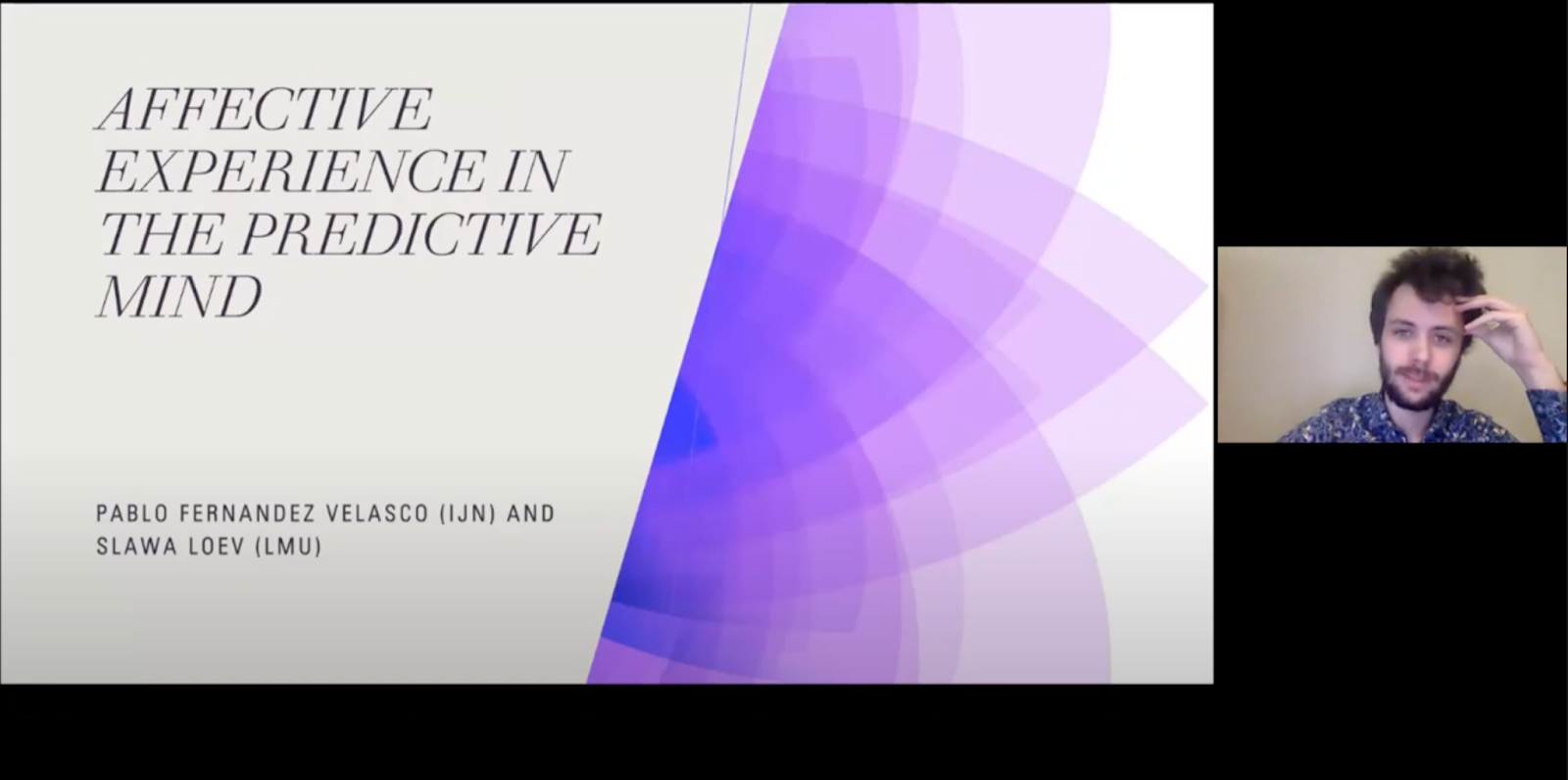
Doctoral candidate Pablo Fernández (Institut Jean Nicod) gave the final talk of the day, entitled "Affective Experience in the Predictive Mind". Pablo reviewed a number of existing accounts of affective experience within Predictive Processing, and suggested a possible means of integrating these views.
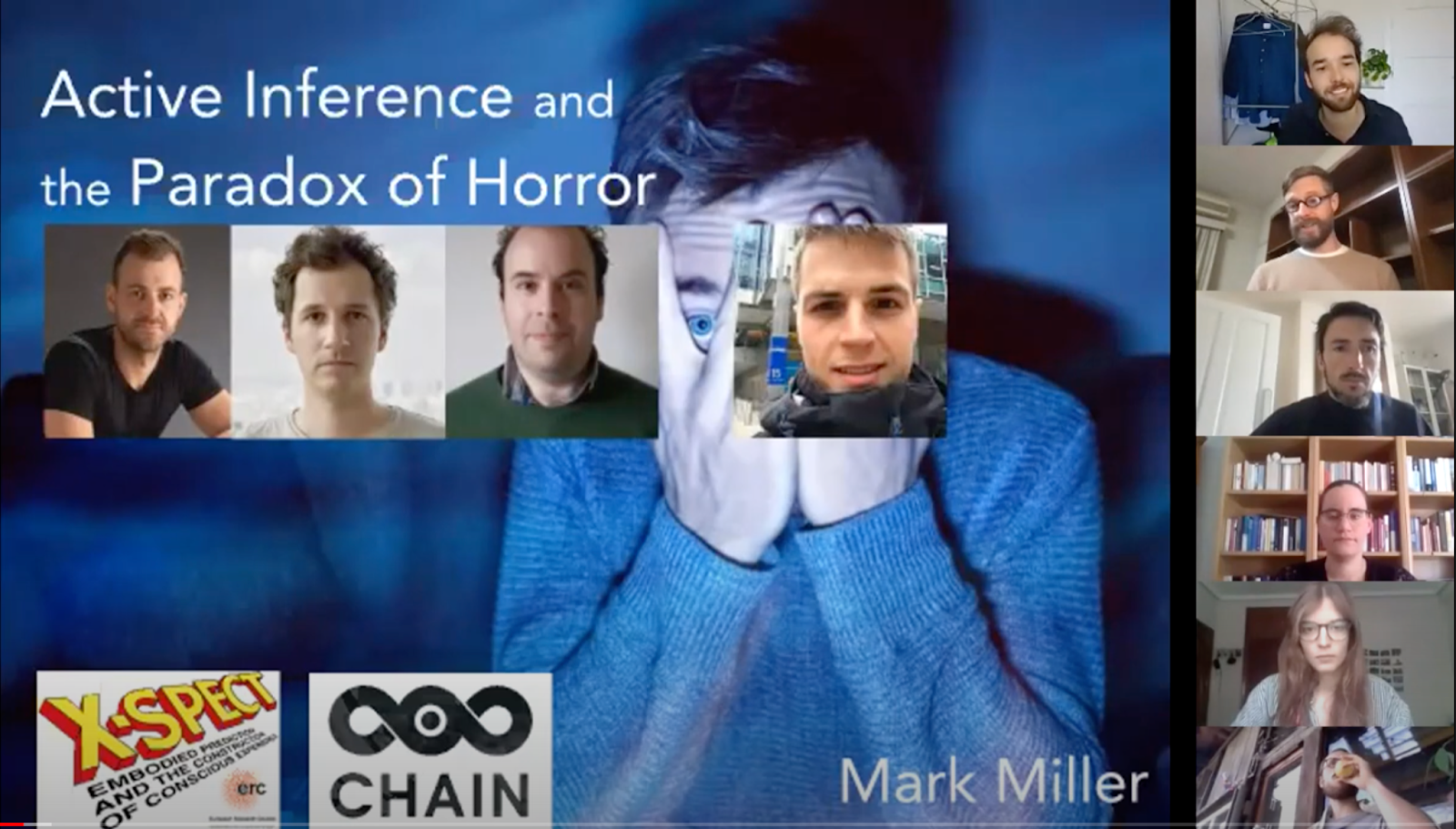


Day two started with Prof. Mark Miller (Center for Human Nature, Artificial Intelligence and Neuroscience, Hokkaido University) presenting his talk "Active Inference and the Paradox of Horror". Starting from the active inference framework, Mark discussed why an agent striving to minimize surprise would find pleasure in engaging with unpredictable horror films. The answer, he proposed, lies in what he called “consumable error” - prediction errors with just the right amount of complexity. It is the carefully curated consumable errors that horror films produce that makes watching horror films enjoyable (and potentially beneficial).


Abby Tabor


Next, behavioural scientist Dr. Abby Tabor (University of the West of England) presented a talk "Pain and Suffering: An Active Inference Perspective". Abby developed a predictive processing account of the experience of pain, where the concept of suffering was understood in relation to constrained action. Anticipating a loss of bodily integrity, the individual in pain is afforded a narrowed repertoire of action. On the one hand, Abby argued, this constraint presents an opportunity to reduce the likelihood of more harm, on the other, it risks compromising the ability to attune to the environment in healthy ways. 



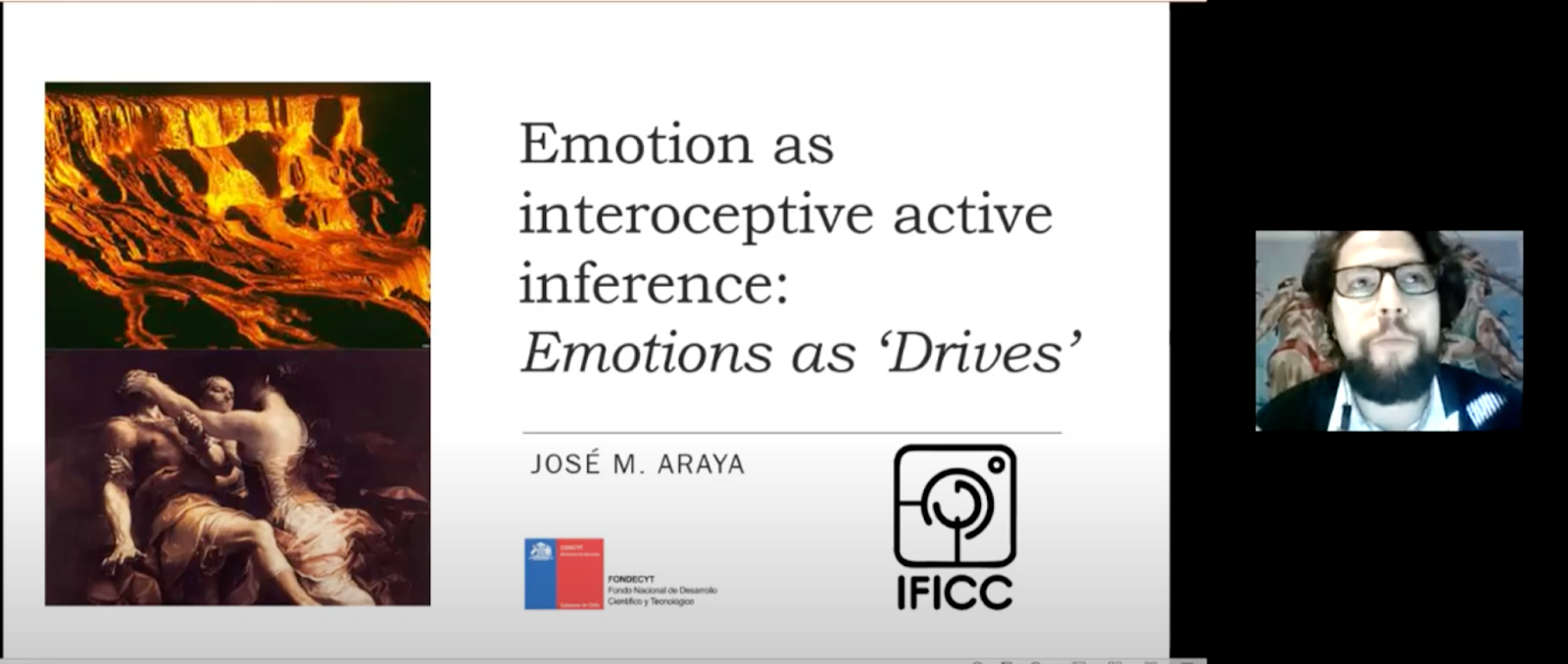
Dr. José M. Araya (Instituto de Filosofía y Ciencias de la Complejidad) closed the workshop with his talk "Following Your Guts: Interoceptive Expectations and the Loops of Emotion". Jose began from the assumption that an account of emotion can be gleaned by drawing an analogy with the mechanisms and dynamics within the visual modality. While this approach captures many aspects of emotion, Jose argued that this approach fails to account for the motivational character of emotion and its dynamics of self-organization. 

Videos of the talks can be found here

Popular posts from this blog

Delusions in the DSM 5

This post is by Lisa Bortolotti. How has the definition of delusions changed in the DSM 5? Here are some first impressions. In the DSM-IV (Glossary) delusions were defined as follows: Delusion. A false belief based on incorrect inference about external reality that is firmly sustained despite what almost everyone else believes and despite what constitutes incontrovertible and obvious proof or evidence to the contrary. The belief is not one ordinarily accepted by other members of the person's culture or subculture (e.g., it is not an article of religious faith). When a false belief involves a value judgment, it is regarded as a delusion only when the judgment is so extreme as to defy credibility.

Motivated Reasoning in Science

Today's post is by Josh May (University of Alabama, Birmingham). In this post, he talks about one of his papers published in Synthese and entitled " Bias in Science ". Josh May Much discussion of the replication crisis in science has focused on the social sciences, particularly psychology. A common narrative is that the social sciences are particularly susceptible to powerful biases, such as moral and political ideology. I argue instead for a parity thesis: all areas of science are subject to bias, through the general psychological mechanism of motivated reasoning . This provides a unified framework for understanding how values influence the entire scientific enterprise. The scientific process involves numerous decisions that can be influenced by one's values--including moral, political, and prudential values--which manifest as goals or motivations. A researcher wants badly, say, to publish in a prestigious journal in order to either advance her career or maintain ...

Rationalization: Why your intelligence, vigilance and expertise probably don't protect you

Today's post is by Jonathan Ellis , Associate Professor of Philosophy and Director of the Center for Public Philosophy at the University of California, Santa Cruz, and Eric Schwitzgebel , Professor of Philosophy at the University of California, Riverside. This is the first in a two-part contribution on their paper "Rationalization in Moral and Philosophical thought" in Moral Inferences , eds. J. F. Bonnefon and B. Trémolière (Psychology Press, 2017). We’ve all been there. You’re arguing with someone – about politics, or a policy at work, or about whose turn it is to do the dishes – and they keep finding all kinds of self-serving justifications for their view. When one of their arguments is defeated, rather than rethinking their position they just leap to another argument, then maybe another. They’re rationalizing –coming up with convenient defenses for what they want to believe, rather than responding even-handedly to the points you're making. Yo...