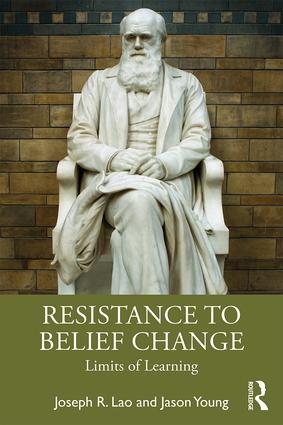
Today's post is by Joseph Lao (Columbia University and CUNY) and Jason Young (CUNY) who introduce their new book, Resistance to Belief Change (Routledge 2019).

The general perspective of our book may best be described as doxastic psychology. We share with the doxastic philosophers and Jean Piaget’s genetic epistemology an interest in the genesis and transformation of our beliefs. We differ from both however, in our particular focus on issues of embeddedness and entrenchment, and in our careful examination of a broad range of psychological factors, including emotional, cognitive, social, and physical factors, that cause us to resist changing our beliefs and impede our achievement of epistemic sainthood.
We avoid the assumption that resistance to belief change in response to evidence that contradicts our beliefs is necessarily irrational. We note several examples of how such resistance may be “illogical” yet rational, such as when we lack a superior alternative to our existing beliefs, or when a false belief accrues positive consequences. An example of the latter occurs when one spouse convinces the other that he cannot cook and thereby gains freedom from the responsibility of cooking.
We construe our tendency to resist belief change as a general tendency that is manifested in many specific ways, across a broad array of human domains. We identify many, often unintentional, and even unconscious, “mechanisms” by which we preserve our beliefs intact. For example, we are biased to search for evidence that supports beliefs we wish to be true rather than evidence that contradicts our cherished beliefs. There is ample evidence to support the view that it is easier for us to form beliefs than to discard them, that is, the latter literally requires more cognitive effort.
In spite of our natural tendency to resist change, we do of course change. Change is the way we grow, and we definitely do grow. Therefore, in the last two chapters of our book we offer ideas for overcoming resistance, either as self-directed learners or as “teachers.” Drawing on psychological research, philosophy and the philosophy of science, we suggest that establishing clear, reasonable, epistemic standards, committing to an open mind, and epistemic integrity are effective ways to overcome resistance in ourselves, while having learners collaborate in social problem solving are effective ways to help others overcome resistance.
The general perspective of our book may best be described as doxastic psychology. We share with the doxastic philosophers and Jean Piaget’s genetic epistemology an interest in the genesis and transformation of our beliefs. We differ from both however, in our particular focus on issues of embeddedness and entrenchment, and in our careful examination of a broad range of psychological factors, including emotional, cognitive, social, and physical factors, that cause us to resist changing our beliefs and impede our achievement of epistemic sainthood.
We avoid the assumption that resistance to belief change in response to evidence that contradicts our beliefs is necessarily irrational. We note several examples of how such resistance may be “illogical” yet rational, such as when we lack a superior alternative to our existing beliefs, or when a false belief accrues positive consequences. An example of the latter occurs when one spouse convinces the other that he cannot cook and thereby gains freedom from the responsibility of cooking.
We construe our tendency to resist belief change as a general tendency that is manifested in many specific ways, across a broad array of human domains. We identify many, often unintentional, and even unconscious, “mechanisms” by which we preserve our beliefs intact. For example, we are biased to search for evidence that supports beliefs we wish to be true rather than evidence that contradicts our cherished beliefs. There is ample evidence to support the view that it is easier for us to form beliefs than to discard them, that is, the latter literally requires more cognitive effort.
In addition, the phenomenon known as “inattentional blindness” is mediated by our parietal lobe and may literally blind us to evidence that contradicts some of our beliefs. Socially, we associate with other people partly on the basis of shared beliefs. In some cases, the costs of discarding a shared social belief may include being ostracized by an important part of our social support network (such as our church or political party). But we are a social species, for which such ostracism may be at least unpleasant, and possibly fatal. Finally, we note that our beliefs are mediated by still poorly understood neural structures. Once a neural structure constituting a belief has been formed, it becomes more and more firmly embedded as it gets used and reused, thereby offering more and more physical resistance to change.
 |
| JasonYoung |
 |
| Joseph Lao |
In spite of our natural tendency to resist change, we do of course change. Change is the way we grow, and we definitely do grow. Therefore, in the last two chapters of our book we offer ideas for overcoming resistance, either as self-directed learners or as “teachers.” Drawing on psychological research, philosophy and the philosophy of science, we suggest that establishing clear, reasonable, epistemic standards, committing to an open mind, and epistemic integrity are effective ways to overcome resistance in ourselves, while having learners collaborate in social problem solving are effective ways to help others overcome resistance.